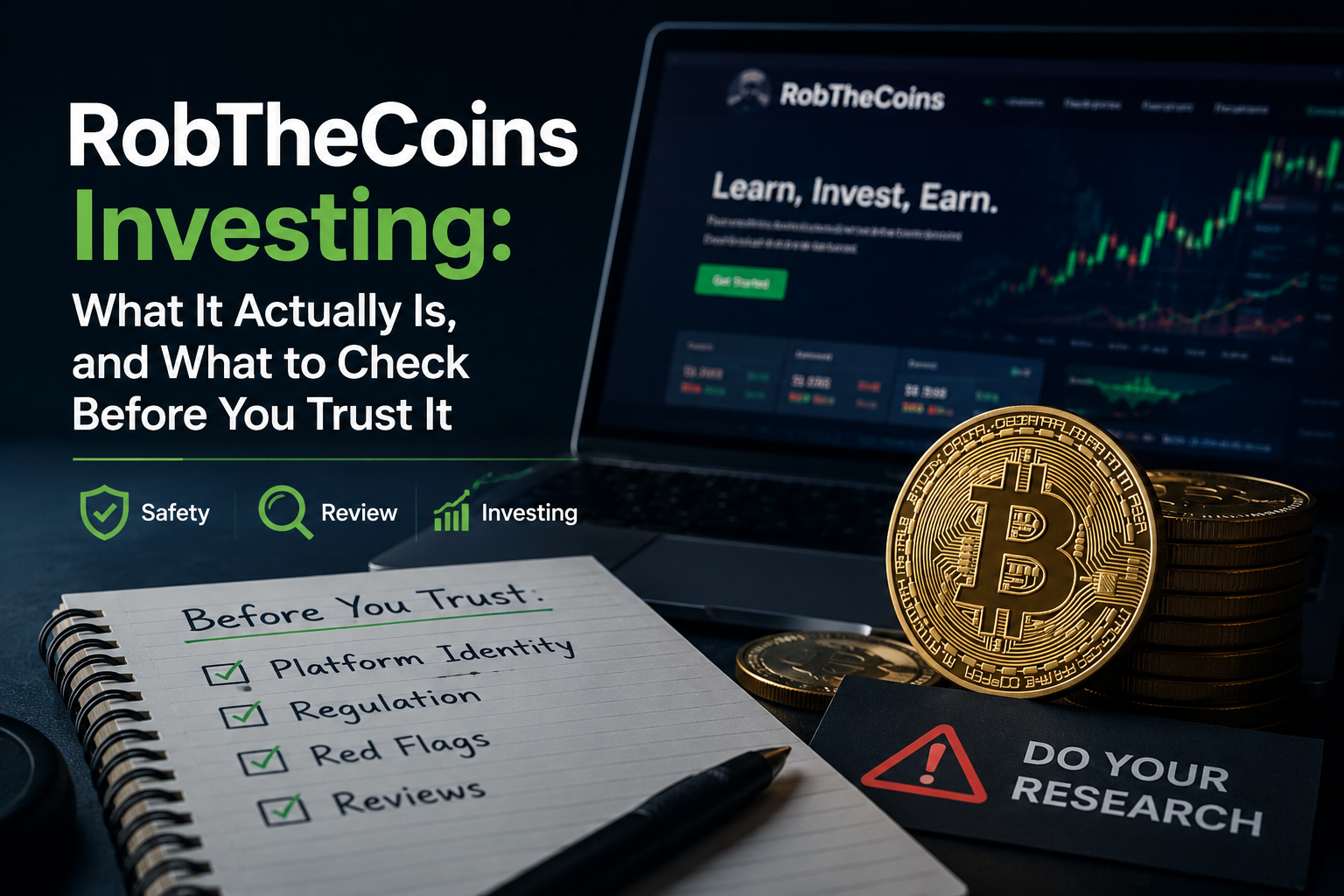
If you searched “robthecoins investing,” you’ve probably noticed something odd. The results point to at least two websites and several near-identical review articles. No single result clearly explains what RobTheCoins actually does. RobTheCoins isn’t one platform with one clear identity. The name covers a content blog, a separate affiliate site, and an earning platform. The platform reportedly mixes crypto trading, task rewards, and referrals. Before you spend time or money on anything under this name, first identify which one you’re actually viewing.
What Is RobTheCoins? (Untangling a Confusing Name)
There isn’t a single official “RobTheCoins.” Search results surface at least two separate websites using the name. They also surface a separately described earning platform. Different articles use the name for at least four things:
- robthecoins.net publishes educational articles about crypto, investing, and business tips. Its own “About Us” page calls it an informational blog. The page says it doesn’t provide financial advice or name its team.
- robthecoins.com is a broader content and affiliate site. Alongside crypto and investing posts, it publishes content about online casinos, sports betting, VPN services, and gaming. Its footer includes affiliate links to gambling platforms. Its “About” section names two people, Fyona Menas and Reg Payton, as the founders.
- Separate reviews describe a “Business RobTheCoins” earning platform. It involves crypto deposits, daily “spin” games, token rewards, and referral commissions. Multiple users report frozen accounts and vanished balances after large withdrawal requests.
- At least one older article describes “Rob The Coins” as a browser-based coin-collecting game. It has no financial component, just solo missions and team hunts for in-game rewards.
That’s four meaningfully different things sharing one name. Different articles describe them without clear links showing that they share the same operation. This kind of inconsistency is itself worth noticing. When a financial platform gets contradictory descriptions, people may have reused the name across unrelated projects. That differs from a single, stable, verifiable business.
Why the Search Results Are So Confusing
If you’ve clicked through several “robthecoins” articles, you’ve probably noticed how similar they read. They use similar structures and phrases like “smart investing” and “structured framework.” They also call the platform “beginner-friendly.” That’s not a coincidence. Both robthecoins.net and robthecoins.com publish large volumes of near-identical content across crypto, gaming, and business topics. They also use affiliate links to products like online casinos and VPN services. That pattern includes high article volume, generic phrasing, and affiliate monetization. It suggests these sites mainly target search traffic and generate ad or referral revenue. It does not show that they represent one coherent financial platform.
Separately, at least one review describes a distinct “Business RobTheCoins” platform in far more troubling terms. A WHOIS lookup reportedly shows anonymized domain ownership. Users on Reddit’s crypto-scam communities report vanished token balances after spin games and referral activity. Some users also report promises of 200 to 300 percent returns within 30 days. The figure closely matches the “guaranteed high returns” pattern that the CFTC lists as a fraud hallmark. That review is a single source. A second outlet has not independently corroborated it. This article therefore presents it as a reported claim, not an established fact. But it gives a more specific and alarming description than either robthecoins.net or robthecoins.com. That detail can get lost when articles treat “RobTheCoins” as one simple thing.
None of this proves fraud. You should still treat every article describing “RobTheCoins,” including this one, with the same skepticism you would apply to any unverified source. Do not treat an article as an official statement from the entity you may deal with.
How RobTheCoins Reportedly Works
Based on independent reviews of the platform side of RobTheCoins, the reported structure includes:
- Trading. Users can reportedly buy and trade cryptocurrencies directly, similar to a standard exchange.
- Task-based earning. Completing activities like reading articles, answering quizzes, or engaging with sponsored content reportedly earns small crypto rewards.
- Referrals. Users can reportedly earn a percentage of activity generated by people they refer to the platform.
- Education. The platform reportedly offers guided tutorials and simulated trades before beginners risk real funds.
- Onboarding. At least one review reports that sign-up doesn’t require heavy identity verification (KYC) upfront, which is a notable difference from more regulated exchanges.
Worth noting: third-party reviews report these features. No verified official RobTheCoins source has confirmed them. No single verifiable entity has published terms that independent reviewers can check.
Is RobTheCoins Regulated?
No independent review found evidence of RobTheCoins registration with the U.S. Securities and Exchange Commission (SEC) or oversight from another financial regulator. To be precise, this reflects an absence of evidence in third-party reviews and public reporting. It does not reflect a completed SEC or FINRA database search. A written article cannot verify those live results for you. You can run that check yourself using the SEC’s EDGAR filing database and FINRA’s BrokerCheck tool. Investor.gov links to both.
If the company or founder names return no match, treat that as a reason for caution. The SEC and CFTC do not treat a missing result as proof of fraud. It remains one unresolved question before you deposit money.
Red Flags to Check, Mapped to Official Guidance
The Federal Trade Commission (FTC) and Commodity Futures Trading Commission (CFTC) publish specific warning signs for crypto investment fraud. They do so for good reason. In one six-month period, the FTC tracked more than $80 million in reported consumer losses from cryptocurrency investment scams. The median individual loss reached $1,900. That scale explains why regulators publish specific, checkable warning signs instead of leaving people to guess. Here’s how RobTheCoins’ reported features line up against that guidance:
How These Red Flags Apply to RobTheCoins
| Official red flag (FTC/CFTC) | How it shows up here |
|---|---|
| Anonymous or unverifiable team | One site names founders, but no independent source confirms their credentials, registration, or track record |
| Heavy reliance on referrals to earn money | Independent reviews describe a referral system that some third-party sources compare to a multi-level marketing (MLM) structure |
| “Guaranteed” high returns with little risk | One review reports promises of 200 to 300 percent returns within 30 days. That figure exceeds the 20 to 50 percent range the CFTC flags as a fraud hallmark |
| Light or absent identity verification | At least one review reports minimal KYC at sign-up, unlike regulated exchanges |
| Reports of withdrawal trouble | Multiple independent sources describe frozen accounts or vanished balances after large withdrawals or spin activity. These reports involve individual accounts, not confirmed platform-wide issues |
| Unclear or unverifiable regulatory status | No independent source could confirm SEC, CFTC, or other regulatory registration |
None of this proves RobTheCoins is a scam. Several patterns that regulators tell consumers to check for appear here or remain unresolved. That makes your own verification especially important before you commit any money. The FTC’s guide to cryptocurrency scams covers these patterns in more depth. The CFTC also publishes an investor alert on fraudulent digital-asset trading websites.
RobTheCoins vs. Coinbase and Binance
RobTheCoins isn’t really in the same category as Coinbase or Binance. This table shows what a regulated baseline looks like. It does not suggest that the three are interchangeable options.
| Feature | RobTheCoins | Coinbase | Binance |
|---|---|---|---|
| Regulatory status | Unclear or unconfirmed | SEC-registered in the US | Varies by region |
| Identity verification | Reportedly minimal | Required | Required |
| Core focus | Education, task earning, referrals | Simple regulated entry point | Advanced trading tools |
| Deposit protections | None confirmed | Standard exchange protections apply | Standard exchange protections apply |
| Best suited for | Unclear, proceed with caution | Beginners wanting a regulated option | Experienced traders |
How to Protect Yourself Before Trying Any Platform Like This
These steps apply to RobTheCoins specifically. They also work for any unfamiliar crypto platform:
- Search the platform’s name alongside “scam,” “review,” and “complaint” before you sign up or deposit anything.
- Never treat a referral bonus or task-based reward as evidence of legitimacy. Scammers use both.
- Confirm regulatory status yourself through Investor.gov or your state securities regulator rather than trusting a platform’s own claims.
- Start with the smallest possible amount if you decide to test a platform. Don’t add more until you confirm that you can withdraw successfully.
- Treat “guaranteed returns” or pressure to act quickly as an immediate stop sign. Legitimate investments don’t guarantee profit.
- Read a platform’s terms and withdrawal policy before depositing anything, not after you’ve tried to cash out.
- Keep any crypto you test on a platform separate from your main holdings. That way, one bad experience won’t put everything at risk.
Frequently Asked Questions
Is RobTheCoins legit or a scam?
No independent review has confirmed an outright scam. None has confirmed a fully regulated, transparent platform either. Rather than looking for a yes-or-no verdict online, verify the details that matter. Identify the legal operator. Check its registration. Look for users who confirm successful large withdrawals, not just small test payouts.
Why do different articles describe RobTheCoins so differently?
Because “RobTheCoins” isn’t one verified thing. Depending on the article, writers describe it in different ways. They call it an educational blog, an affiliate site, a crypto earning platform, or a coin-collecting game. That inconsistency across sources suggests a reused or ambiguous name rather than one accountable operator.
Is RobTheCoins regulated by the SEC or CFTC?
No independent source has confirmed registration with either agency. Check EDGAR and BrokerCheck yourself using the specific company or founder names. Do not rely on an article’s claim either way.
Can I easily withdraw money from RobTheCoins?
Multiple independent reviews describe frozen accounts or vanished balances. These reports follow larger withdrawals or spin and referral activity. Users reported these experiences. They do not confirm a platform-wide pattern, but separate reports make them worth taking seriously.
Is RobTheCoins good for crypto beginners?
Its educational content and simulated trading may appeal to beginners. Beginners may also struggle to spot the red flags described above. If you’re new to crypto, that calls for more caution, not less.
How does RobTheCoins reportedly make money?
Reviews describe trading fees, advertising, task-based rewards, and referral commissions as reported revenue sources. No official, verifiable source confirms these claims.
Bottom Line
RobTheCoins isn’t a single, clearly defined platform. The name covers at least four descriptions. These include an educational blog, an affiliate site, an earning platform with reported withdrawal problems, and an unrelated coin-collecting game. No independent source confirms any of them as regulated or transparent about who runs them. That inconsistency alone is worth pausing on. Reports of guaranteed-sounding returns, referral-heavy earning, and frozen withdrawals add to the concern. Several patterns that regulators tell consumers to check for appear here or remain unresolved. If you’re considering it, verify registration through EDGAR and BrokerCheck. Confirm which website or entity you’re dealing with. Start small. Never treat referral earnings or task rewards as proof that a platform is safe.