
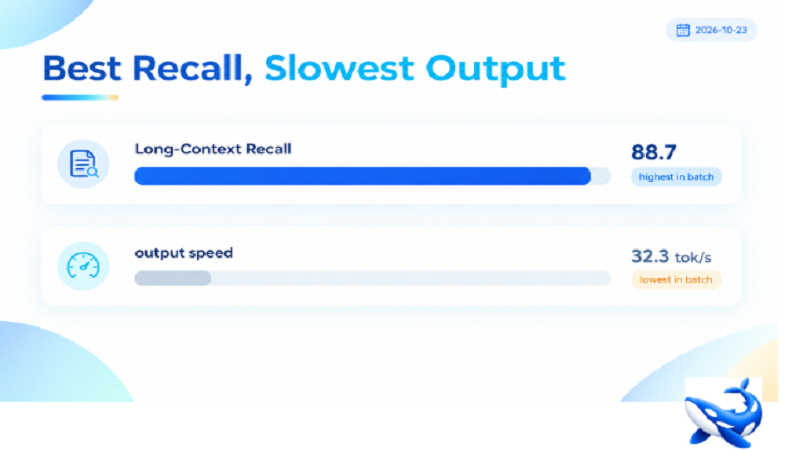
Kimi K3 scores 88.67 on Long-Context Recall, the highest reading of that benchmark on any card in this batch, and generates at 32.3 output tokens per second, the slowest of the 21 cards measured [OURS]. Both numbers are on the same card, under the same seven-day window. The kimi k3 price query lands there. The card is served by OrcaRouter.
The two extremes
Long-Context Recall asks whether a model can find a fact buried in a long input. The scores in this catalogue run from the low seventies to the high eighties; 88.67 is the top of that range.
Output speed asks how fast the model writes once it starts. The cards in this batch run from 32 to 610 tokens per second; this is the bottom.
The pairing is not a coincidence. A model that spends its compute reading a million-token context has less left over for generating, and a card built for retrieval-heavy work will show exactly this trade: excellent recall, slow output.
For a workload, the trade is usually worth it. Reading is a one-time cost per request; generation is the part the user waits through. If the answer is 300 tokens, 32 tokens per second means nine seconds of writing — acceptable. If the answer is 3,000 tokens, it means ninety seconds, and that is a different product.
The rest of the nine rows
| Row | Score |
| GPQA Diamond | 93.5 |
| terminalbench_v2_1 | 85.0 |
| Long-Context Recall | 88.7 |
| AA Coding | 76.2 |
| SciCode | 59.5 |
| Humanity’s Last Exam | 46.9 |
| tau_banking | 46.0 |
| AA Intelligence | 43.6 |
| terminalbench_v4_0 | 12.6 |
Eight of nine rows are strong: GPQA at 93.5, coding at 76.2, HLE at 46.9. The outlier is terminalbench_v4_0 at 12.6, which sits with the older generation rather than with the Fable-class cards at 42 to 52.
So the profile is: excellent at reading and knowledge, good at coding and tool use, weak on the newest long-horizon terminal benchmark. That last row is the one that limits agentic claims.
The envelope has a hole in it
The card publishes a 1,048,576-token context and a maximum output of 0 [OURS] — that is, no stated ceiling.
On a card whose entire pitch is long-context work, the output ceiling is the second half of the question. Reading a million tokens is only useful if the model can then write enough to be worth reading. The card does not say how much that is.
Combined with the 32.3 tokens per second, the missing field is compounded: a buyer cannot tell whether a long extraction task will finish in a minute or be cut off.
The rate row
| Line | Rate per million | Against input |
| Input | $3.00 | 100% |
| Output | $15.00 | 500% |
| Cached read | $0.30 | 10% |
A 5× output ratio, a 10 percent read, no published cache write [OURS]. At $3.00 input this is a premium-priced card, and the 5× ratio means a retrieval workload with short answers — the shape the recall row points at — is the cheap way to use it.
A 200,000-token context read with a 500-token answer costs $0.60 plus $0.0075 — about $0.61 per request [OURS arithmetic on the published rates]. That is the workload the card is priced for.
Telemetry and traffic
Median time to first token is 4,614 ms, p95 at the 10,000 ms ceiling, error rate 0.10 percent [OURS]. Traffic over seven days was 1,113,750,745 tokens.
One point one billion tokens a week on the slowest card in the batch is a substantial load, and the 0.10 percent error rate says the route handles it.
The search side
The page earned 114 impressions and no clicks at an average position of 12.0 over 28 days [OURS]. The query set is price intent with a couple of odd entries:
| Query | Impressions | Position |
| kimi k3 price | 23 | 8.9 |
| kimi 3 price | 15 | 8.7 |
| kimi k3 pricing | 15 | 8.1 |
| kimi k3 open source | 6 | 37.3 |
| kimi k3 cost | 4 | 6.8 |
| kimi k3 api pricing | 2 | 1.0 |
The price queries sit between 6.8 and 8.9 — page one, bottom half — and take nothing. One query, `kimi k3 api pricing`, ranks first with two impressions, which is the variance you see on a tiny volume.
The `kimi k3 open source` query at position 37.3 is the one query on the card that is not about price, and the page is not the answer to it.
The takeaway
Kimi K3 prices at $3.00 input, $15.00 output and $0.30 cached per million tokens, with a 1,048,576-token context, no stated maximum output, and 88.67 on Long-Context Recall — the best in this batch [OURS].
It also generates at 32.3 tokens per second, the slowest here, and reads 12.6 on terminalbench_v4_0. A model built to read everything and write slowly is a specific tool; the missing output ceiling is the field that would tell you how specific. Click here